
10 Business Travel Backpack Tips for Global Buyers
Choosing the right Business Travel Backpack is no longer a simple matter of appearance. Global buyers must weigh comfort, capacity, durability, security, and professional design. A crowded airport exposes weak shoulder straps quickly. A sudden rain shower tests fabric and zippers. A long meeting reveals whether the laptop compartment protects equipment properly.
Doug Dyment, founder of OneBag.com and a respected travel-packing expert, says, “The less you carry, the more you enjoy your journey.” His principle remains useful for business travelers. A practical backpack should hold a laptop, documents, chargers, a change of clothing, and small daily essentials without becoming bulky. It should also fit different body shapes and travel routines. However, no design works perfectly for everyone. Some buyers need expandable storage. Others prefer a slimmer profile for trains, offices, and narrow airplane aisles.
This guide examines ten practical Business Travel Backpack tips for global buyers. It considers materials, organization, carrying comfort, device protection, weather resistance, luggage compatibility, and long-term value. Real-world details matter. A smooth luggage sleeve can reduce strain during transfers. Quiet zippers can feel more professional in meetings. A breathable back panel may prevent discomfort after several hours of walking.
Small choices matter. So do honest limitations. A water-resistant bag is not always waterproof. Premium materials may increase weight. More pockets can create clutter instead of convenience. Buyers should compare claims carefully, check dimensions, and consider local travel conditions before purchasing. A dependable backpack should support the journey, not control it.
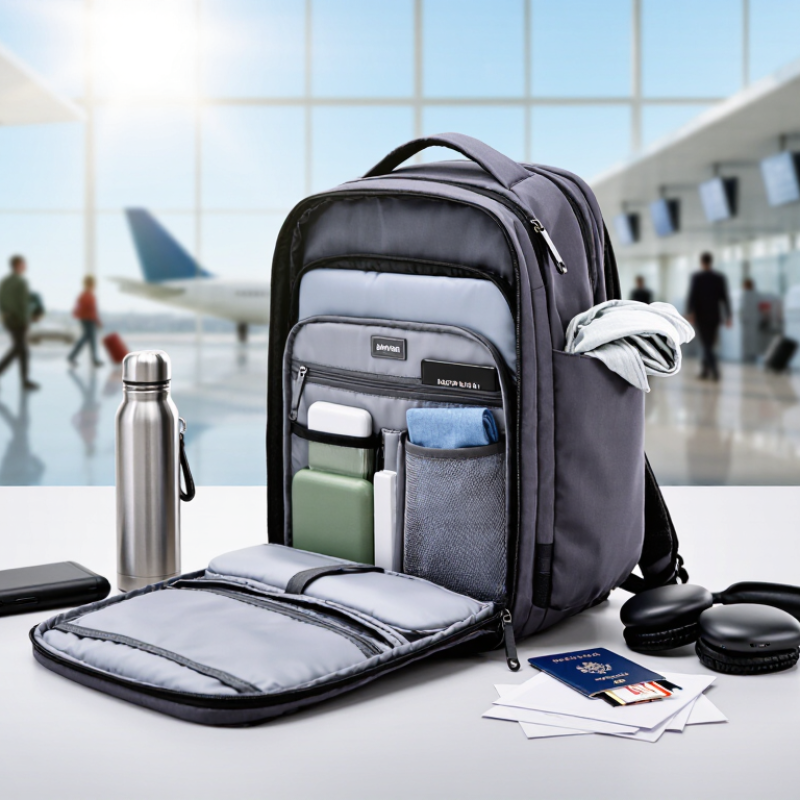
Define the Business Travel Backpack’s Core Purpose and User Profile
A business travel backpack should solve a specific travel problem, not imitate a hiking pack. The Global Business Travel Association’s 2024 BTI report forecasts global business travel spending at about $1.48 trillion in 2024. This scale reflects varied users, from consultants crossing airports weekly to sales teams carrying samples and documents.
Define the user before selecting materials or capacity. A frequent flyer may need a 20–30-liter bag, a padded laptop section, quick-access documents, and stable shoulder straps. A commuter may value water resistance, a luggage sleeve, and discreet organization more than maximum volume. An analyst using IATA passenger guidance should also consider cabin restrictions, because airline limits differ by route and aircraft. A bag that fits one market may fail elsewhere.
Ask practical questions: Is the user traveling for one night or five? Does the laptop leave the bag during security checks? Will the backpack sit beneath a seat, in an overhead compartment, or beside a client’s desk? Field testing should include crowded trains, wet sidewalks, and repeated opening with one hand. Small flaws become expensive over time. This assumption can fail. Overbuilt padding may reduce usable space, while too many pockets can slow access. Reliability often comes from fewer, clearer functions.
Assess Capacity, Organization, and Access for Work Essentials
10 Business Travel Backpack Tips for Global Buyers
A work backpack should fit one intense day, not a weekend. The GBTA Business Travel Index projected global business travel spending at about $1.48 trillion in 2024. That scale reflects frequent movement, tight schedules, and many different work habits. Start with practical capacity: 20–30 liters usually holds a laptop, tablet, documents, charger, headphones, and a light layer without becoming bulky. Measure your largest device before ordering. Manufacturers sometimes describe capacity generously.
Organization matters when a meeting begins in a crowded terminal. Look for a padded laptop compartment, a separate document sleeve, and small cable pockets. Add a structured pen slot, a key leash, and space for a power bank. Keep liquids away from electronics. IATA’s 2024 Global Passenger Survey found that 71% of travelers use smartphones to improve their airport experience, so fast access to phones and charging cables is valuable. A top pocket can hold identification and earbuds. It should close securely.
Access design deserves a real test. A wide-opening main compartment reveals contents quickly, while a back-panel opening may protect devices in crowded places. Check whether zippers work with one hand. Try the bag while seated. Shoulder straps should adjust without digging into the neck, and the back panel should allow airflow. Water resistance helps during sudden rain, but it is not waterproofing. I would also question overly complex pockets; they look impressive, yet they can waste time. Load the backpack with actual work essentials before purchase. That small test often exposes poor balance, weak handles, and unused space.
10 Business Travel Backpack Tips for Global Buyers - Assess Capacity, Organization, and Access for Work Essentials
| No. | Assessment Dimension | Recommended Benchmark | Why It Matters | Buyer Checklist |
|---|---|---|---|---|
| 1 | Usable Capacity | Approximately 20–30 liters for a laptop, documents, chargers, clothing, and daily accessories. | This range balances workday storage with carry-on practicality. Larger capacity can add weight and encourage overpacking. | Measure internal volume, not only external dimensions. Check whether pockets reduce the main compartment significantly. |
| 2 | Laptop Protection | A padded, suspended compartment sized for common 13–16 inch laptops, with soft lining and secure closure. | A suspended sleeve helps reduce direct impact when the backpack is placed on the floor or packed tightly. | Check sleeve dimensions, padding thickness, bottom clearance, closure type, and compatibility with protective cases. |
| 3 | Document Organization | At least 3–5 dedicated sections or pockets for papers, notebooks, pens, cards, and small accessories. | Separated storage reduces search time and helps keep business documents flat and accessible. | Look for varied pocket sizes, pen loops, document sleeves, and light-colored lining for visibility. |
| 4 | Access Design | A wide-opening main compartment plus quick-access pockets positioned for passport, phone, and travel documents. | Fast access is useful during security screening, transit changes, meetings, and hotel check-in. | Test zipper travel, opening angle, one-hand operation, pocket reach, and visibility while standing. |
| 5 | Carry-On Compatibility | Verify the packed dimensions against the current cabin-baggage rules of the intended routes and airlines. | Cabin-size limits vary by carrier, fare type, aircraft, and region, so a universal guarantee is not reliable. | Publish exact external dimensions and advise buyers to confirm current carrier requirements before travel. |
| 6 | Comfort and Load Distribution | Contoured shoulder straps, breathable back padding, an adjustable sternum strap, and balanced weight placement. | Ergonomic contact points can improve comfort during long walks through terminals and urban transit. | Load-test with 5–8 kg, inspect strap width, adjustability, padding recovery, and stability during movement. |
| 7 | Material and Weather Resistance | Abrasion-resistant fabric, reinforced stress points, coated or water-resistant exterior, and covered or water-resistant zippers. | Business travelers may encounter rain, crowded transport, and frequent contact with floors and luggage racks. | Request fabric composition, denier information where available, seam construction, and results from water-resistance testing. |
| 8 | Security Features | Lock-compatible zipper pulls, concealed pockets, durable zipper garages, and discreet exterior styling. | These features can make casual access more difficult in crowded environments, although they do not replace situational awareness. | Check zipper pull compatibility, pocket placement, seam strength, and whether security features slow normal access. |
| 9 | Power and Cable Management | Dedicated cable storage, an internal power-bank pocket, and a pass-through port only where it complies with safety and local-use requirements. | Separate cable storage prevents tangling and keeps charging accessories away from documents and clothing. | Confirm pocket dimensions, cable routing, cleaning access, and whether electronic accessories are included or sold separately. |
| 10 | Weight, Durability, and Serviceability | Keep the empty backpack reasonably light for its capacity, with reinforced handles, replaceable pulls where possible, and documented quality testing. | A lighter bag preserves more of the traveler's baggage allowance for work materials while durable construction supports repeated use. | Compare empty weight, stitching, handle attachment, base reinforcement, repair options, warranty terms, and packaging efficiency. |
Compare Materials, Comfort Features, and Long-Term Durability
10 Business Travel Backpack Tips for Global Buyers
Choose fabric by use, not appearance. High-denier recycled polyester resists abrasion and handles frequent airport contact. Textile Exchange’s 2024 Materials Market Report shows recycled polyester remains widely used in global textile production. However, recycled content alone does not prove durability. Ask for abrasion, seam, zipper, and colorfastness test results.
Check comfort with a loaded sample. Padded shoulder straps, breathable back panels, and a stable sternum strap reduce pressure during long transfers. Keep the laptop close to the back. A structured sleeve prevents movement and protects corners. Include a luggage pass-through, but inspect its stitching carefully. The feature is useful.
Use real travel conditions.
Measure capacity in liters. Confirm cabin dimensions for target markets, because airline limits differ. The 2024 GBTA Business Travel Index estimated global business travel spending at about 1.5 trillion dollars, showing why repeated-use performance matters. Select water-resistant fabric, sealed lining, and covered zippers for unpredictable weather. Water-resistant is not waterproof. Buyers sometimes confuse them. I have also found that excessive compartments waste space and add weight. A simpler interior may work better. Test handles, strap anchors, and base panels with repeated-load cycles. Request warranty terms, repair options, and spare-part availability. Long-term durability includes service, not only strong fabric. Assess weight honestly; a premium feel can hide unnecessary bulk. A lightweight bag with reinforced stress points is often the more practical choice.
Check Security, Technology Compatibility, and Travel Regulations
Tip: Check security before choosing a business travel backpack. Select a design with visible compartments and smooth, lockable zippers. Keep passports, phones, and access cards in separate areas. A crowded bag slows screening and increases the chance of leaving something behind. I once packed a charger beside loose coins, which created unnecessary delays. Clear organization matters more than extra pockets.
Tip: Confirm technology compatibility with your daily devices. Measure your laptop, tablet, and power bank before ordering. The laptop sleeve should hold the device without forcing the zipper. Check whether the backpack includes cable routing and padding around charging equipment. Test the loaded bag at home. It may feel balanced empty, but uncomfortable after eight hours.
Tip: Review current travel regulations from official airline and government sources. Battery capacity limits, liquid rules, and cabin size requirements can vary by route. Do not rely only on an old packing list or a retailer’s description. Some destinations also require careful declaration of electronic equipment. Keep chargers and documents easy to remove during inspection. Regulations change, and I have learned that yesterday’s advice may already be incomplete.
10 Business Travel Backpack Tips for Global Buyers
Key security, technology compatibility, and travel-regulation reference points for international business travel.
Use a backpack with quick-access security compartments, a laptop sleeve, water-resistant materials, lockable zippers, and organized cable storage. The chart shows common reference thresholds: liquids are generally limited to 100 mL per container, power banks up to 100 Wh are commonly accepted in carry-on baggage, and power banks between 100 Wh and 160 Wh typically require airline approval. Destination passport-validity rules and airport procedures can vary, so travelers should confirm requirements before departure.
Evaluate Suppliers, Customization Options, Pricing, and After-Sales Support
Global buyers should treat supplier evaluation as a risk decision, not a catalog exercise. The Global Business Travel Association’s 2024 Business Travel Index estimated global business travel spending at $1.48 trillion in 2024. Demand is substantial. Quality failures become expensive quickly.
Request factory audit records, recent test reports, and production photos. Check fabric abrasion, zipper strength, stitching density, and laptop-compartment padding. Ask for a pre-production sample before approving volume. A sample can expose poor balance or uncomfortable shoulder straps. It happened in my own sourcing review. The drawings looked excellent, but the loaded backpack felt unstable.
Do not trust photos alone. Verify capacity, dimensions, carton weight, minimum order quantity, and lead time in writing. The International Trade Centre’s SME Competitiveness Outlook highlights reliable business processes and supply-chain capabilities as important factors in international trade.
Customization should solve user problems, not merely add decoration. Useful options include a trolley sleeve, hidden passport pocket, cable organizer, rain cover, and removable compartments. Confirm material composition, color tolerance, logo placement, and packaging requirements. Small changes can alter tooling costs and delivery schedules. Pricing must include samples, molds, inspection, freight, duties, and replacement units. The lowest quotation is rarely the lowest landed cost.
After-sales support needs measurable terms. Request a defect threshold, response time, spare-part policy, and replacement process. The U.S. Travel Association reported that business travel remains a major contributor to economic activity, making dependable equipment commercially meaningful. Still, forecasts can change. Review supplier performance every quarter, keep records, and leave room for uncomfortable questions.
Related Posts
-
Practical Solutions for Best Work Backpack Issues in Various Industries
-
5 Reasons the Best Business Travel Backpack Enhances Your Global Sourcing Experience
-

Essential Tips for Choosing a Waterproof Backpack?
-
How to Choose the Best Small Travel Backpack for Your Global Adventures
-
What Makes an Away Backpack the Ultimate Adventure Companion?
-
Discover the Ultimate Business Backpack: Elevate Your Professional Style and Efficiency