
How to Choose the Best Waterproof Rucksack?
Choosing the best Waterproof Rucksack starts with evidence, not attractive product photos. The Outdoor Industry Association’s 2024 Outdoor Participation Trends Report recorded 175.8 million active Americans in 2023. That participation supports demand for dependable packs during commuting, hiking, cycling, and travel. Market research reports also identify outdoor equipment as a growing global category, although their forecasts vary by methodology. Treat those numbers carefully. They indicate interest, not guaranteed product quality.
A practical evaluation should examine fabric construction, hydrostatic resistance, seam sealing, closure design, and load comfort. A roll-top opening can protect clothing during heavy rain. However, weak shoulder stitching may still fail under a loaded pack. Look for laboratory testing, warranty terms, repair access, and clear material specifications. “Waterproofing is not a one-off treatment; it is part of garment care,” says Nick Brown, founder of Nikwax, whose work focuses on outdoor waterproofing and textile maintenance. His point matters. Even a strong coating can lose performance through abrasion, dirt, and poor washing.
My first choice was wrong.
I once judged a rucksack by its waterproof fabric alone. The back panel became sweaty, and the narrow straps hurt after several hours. That experience changed my priorities. A reliable Waterproof Rucksack must balance water protection, ventilation, durability, capacity, and fit. The European Outdoor Group’s State of Trade reports also show why durable, repairable equipment deserves attention as consumers become more selective. Still, no pack is perfect. Check the specifications, test the harness with real weight, and consider a dry liner for electronics. This guide explains how to compare those details with greater confidence.
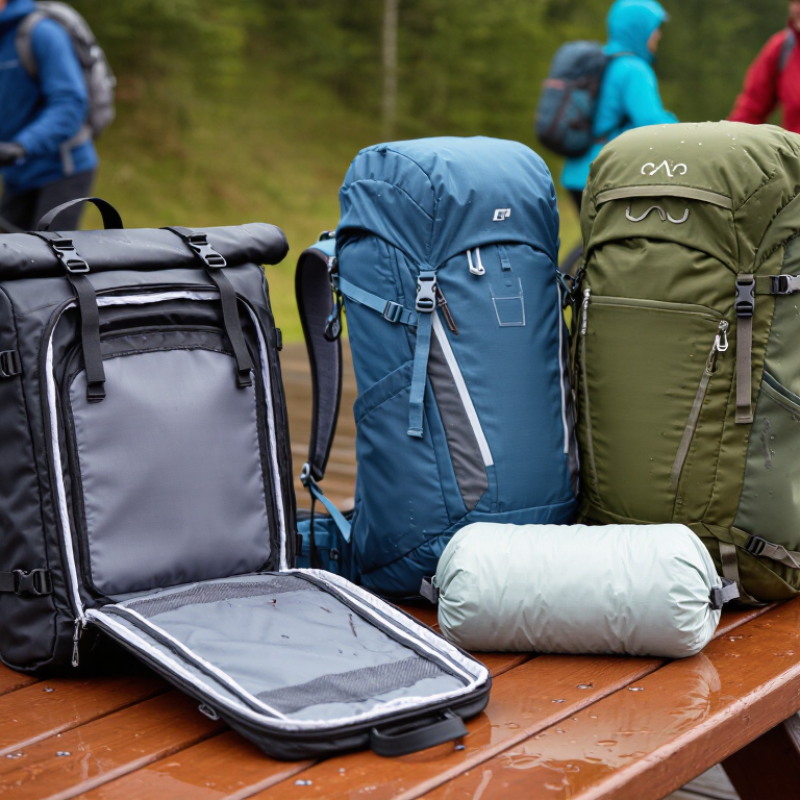
Define Waterproofing: Interpret IEC 60529 IPX4 and IPX7 Ratings
Choosing a waterproof rucksack starts with understanding the IPX rating, not trusting the word “waterproof.”
IEC 60529 defines IPX4 as protection against water splashing from every direction. A rucksack with this level can handle light rain, dripping branches, and wet commuting. It is not designed for submersion. IPX7 means temporary immersion in water up to one metre for 30 minutes under controlled laboratory conditions. That sounds stronger, but IPX7 alone does not automatically confirm strong splash protection. Check whether the product states both ratings.
Small details matter. A certified shell may still leak through an open zipper, stitched seam, or damaged buckle. I once saw water enter through a folded top closure, not the fabric. That was a useful mistake. Test the complete bag, not only its outer panel.
The Outdoor Industry Association’s 2024 Outdoor Participation Trends Report recorded 175.8 million American participants in outdoor recreation during 2023. More users now carry electronics, medicines, and documents outdoors, increasing the cost of moisture damage. For daily cycling, IPX4 may be practical and lighter. For kayaking or accidental drops into shallow water, IPX7 offers better protection, but internal pockets still need attention. Look for test conditions, closure design, and seam construction. Marketing language can be vague. The rating label cannot replace judgment.
How to Choose the Best Waterproof Rucksack? - Define Waterproofing: Interpret IEC 60529 IPX4 and IPX7 Ratings
| Evaluation Dimension | IPX4 | IPX7 | What It Means for a Rucksack | Selection Guidance |
|---|---|---|---|---|
| Protection category | Both ratings describe protection against water under specific laboratory test conditions. They do not define protection against dust, impact, abrasion, or chemicals. | Check the complete product specification rather than treating the IP rating as a general measure of overall durability. | ||
| IEC 60529 test condition | Water splashed against the enclosure from any direction. | Temporary immersion in water up to 1 metre deep for up to 30 minutes. | The test applies to the tested enclosure configuration, not automatically to every pocket, opening, seam, or accessory attached to a rucksack. | Look for test information covering the complete rucksack, including closures and external compartments. |
| Typical outdoor exposure | Light rain, roadside spray, accidental splashes, and wet-weather commuting. | Brief accidental submersion, such as a fall into shallow water, when the product is correctly closed. | IPX4 is aimed at splash resistance; IPX7 provides a higher level of temporary water-ingress protection when immersion conditions are relevant. | Choose IPX4 for normal rainy conditions. Consider IPX7 when accidental drops into water are a realistic risk. |
| Water pressure and jets | Does not certify protection against powerful water jets. | Does not certify protection against powerful water jets or continuous high-pressure spray. | Neither rating alone confirms resistance to pressure washing, hose jets, or storm-driven spray at high force. | For high-pressure exposure, look for a separately stated water-jet rating, such as IPX5 or IPX6, where appropriate. |
| Coverage of openings | Performance depends heavily on the flap, zipper, roll-top, and pocket design. | All openings must be properly closed for immersion protection to be meaningful. | An IP rating cannot protect contents if the rucksack is left open or if water enters through an unsealed opening. | Prefer roll-top closures, protected zippers, storm flaps, and clearly defined closure instructions. |
| Seams and construction | Water-resistant fabric and covered seams may be adequate for splashes, depending on construction. | Immersion protection generally requires carefully sealed seams, compatible materials, and a tested enclosure design. | Fabric coating alone does not make a rucksack waterproof; stitching and seam construction can become water-entry paths. | Check whether seams are taped, welded, or otherwise sealed, and whether the stated rating covers the finished product. |
| Rating relationship | Specifically confirms splash protection. | Specifically confirms temporary immersion protection, but does not automatically confirm every lower water-test rating. | Under IEC 60529, an IPX7 marking should not automatically be interpreted as protection against water jets or splashing unless those tests are also stated. | If both splash and immersion performance are important, look for dual markings or separate test claims, such as IPX4/IPX7. |
| Best-suited use case | Daily commuting, city travel, school, office use, and ordinary rainy-weather activities. | Water-adjacent activities, wet-weather expeditions, and situations where brief accidental submersion may occur. | The right rating depends on the likely water exposure, not simply on choosing the highest number. | Match the rating to the environment, carrying habits, closure discipline, and the value of the contents. |
| Protection of internal contents | Can reduce water entry during splashing when the rucksack is correctly closed. | Can reduce water entry during the specified temporary immersion test when correctly closed. | Neither rating guarantees that contents remain dry in every real-world situation, especially with repeated use, wear, or damaged closures. | Use waterproof inner bags or dry bags for electronics, documents, medicines, and other moisture-sensitive items. |
| Maintenance requirement | Inspect fabric coatings, zippers, flaps, and seams for wear or damage. | Inspect all seals and closures carefully because small defects can compromise immersion resistance. | Water protection can decline through abrasion, contamination, aging, overloading, or incorrect closure. | Clean according to the care instructions, avoid unnecessary abrasion, and replace or repair damaged sealing components. |
| Important limitation | Not designed as a certification for submersion. | Not designed as a certification for prolonged immersion, high-pressure jets, or unrestricted underwater use. | IPX ratings are controlled test classifications, not a guarantee of unlimited waterproof performance in outdoor conditions. | For prolonged exposure, combine the rucksack with a dedicated waterproof liner or dry bag and follow the manufacturer’s instructions. |
Key buying rule: IPX4 is generally suitable for splash and rain exposure, while IPX7 is intended for temporary immersion up to 1 metre for up to 30 minutes under IEC 60529 test conditions. An IPX7 rating alone does not confirm protection against water jets or splashing unless those ratings are separately stated.
Related Posts
-
Essential Tips for Choosing a Waterproof Backpack?
-
Setting the Benchmark for Quality in Best Rucksack Backpack Manufacturing
-

Top 10 Waterproof Backpacks for Every Adventure in 2026?
-
What is a Waterproof Backpack and Why You Need One?
-
What is the Best Travel Laptop Backpack for Your Needs?
-
Ultimate Guide to Choosing the Best Waterproof Rucksack for Your Adventures