Who Are the Best Vietnam Bag Manufacturers in 2026?

Choosing among Vietnam Bag Manufacturers in 2026 takes more than comparing prices or polished product photos. The right partner depends on your bag type, order volume, target market, and tolerance for production risk. A factory suited to canvas totes may not have the same strengths in structured travel bags or technical backpacks. Details matter. Ask how materials are sourced, how samples are approved, and which quality checks happen before cartons are sealed. A close look at seam consistency, zipper operation, lining, and logo placement can reveal more than a brochure.

This guide examines manufacturers through practical criteria: product range, customization, minimum order quantities, production capacity, communication, and quality assurance. It also considers whether a supplier can provide clear specifications, realistic lead times, and evidence behind claims about materials or responsible production. These points should be verified directly; capabilities and standards can vary between facilities and orders. A factory visit or independent inspection may help, but neither replaces a written agreement and an approved reference sample. No ranking is perfect. Some public information may be limited, and the best choice for one buyer may not suit another. Use the profiles as a starting point, then compare quotes and samples against your actual requirements before making a decision.
Who Are the Best Vietnam Bag Manufacturers in 2026?

Vietnam’s Bag Manufacturing Industry in 2026

Vietnam’s bag manufacturing industry in 2026 benefits from an established export base, but production capacity alone does not guarantee consistent quality.

The Vietnam Textile and Apparel Association reported textile and garment exports of about US$44 billion in 2024. That figure describes the wider supply chain, not bag exports specifically. Still, it points to a deep pool of sewing operators, material suppliers, and export-focused factories.

For bag buyers, the practical questions are narrower: Can a factory hold stitch density across a run? Can it match approved colors under consistent lighting? Are zippers and handles tested before packing? Small details show up fast.

Logistics matter, too.

The World Bank’s 2023 Logistics Performance Index placed Vietnam 43rd among 139 economies. That matters. Buyers can use UN Comtrade’s HS 4202 category to examine trade in bags, luggage, and related cases, while checking destinations and year-to-year changes.

Trade figures cannot confirm workmanship, though. A polished sample may not reflect a rushed production line. Ask for a live production check, material records, and inspection results from the actual order.

Lead times also deserve scrutiny; port congestion, fabric delays, or a late color approval can shift shipment dates. Not always. Vietnam offers credible manufacturing depth, but supplier selection still depends on evidence gathered at factory level.

Criteria for Evaluating Bag Manufacturers in Vietnam

A reliable evaluation starts with factory-level evidence, not a country’s reputation. Ask for recent production records, clear material specifications, and samples made with the same fabric, lining, and hardware as the proposed order. Check stitching at stress points, zipper operation, edge finishing, and handle attachment. Small details count. Request documented load, seam-strength, and colorfastness tests where relevant, then compare results with your product requirements.

Logistics deserve a separate check. The World Bank’s 2023 Logistics Performance Index placed Vietnam 43rd among 139 economies, with a score of 3.3 out of 5. That offers useful national context, not proof that an individual factory ships reliably. Review its on-time delivery history, production capacity, and plan for material delays. For quality control, agree on written inspection criteria before production; ISO 2859-1 provides sampling procedures that buyers can adapt. Ask how defects are recorded and corrected, not just whether inspections happen. I would still question any checklist that treats a certificate as a guarantee. A factory visit—or a live video walk-through—can reveal whether sample-room claims match the sewing lines and packing area.

Who Are the Best Vietnam Bag Manufacturers in 2026? — Criteria for Evaluating Bag Manufacturers in Vietnam

Use this practical scorecard to compare factories. The suggested weights are an evaluation framework, not verified ratings of individual manufacturers. Confirm all claims through current documents, samples, and an independent factory assessment where appropriate.

Evaluation criterion Suggested weight What to assess Evidence to request or verify Potential warning signs
Business legitimacy and factory identity 10% Whether the contracting entity, production site, and payment details are consistent and verifiable. Business registration details, factory address, production-site list, contract entity, and a live or third-party site inspection. Unexplained differences between the factory, seller, and contracting entity; refusal to identify the production location.
Social and workplace compliance 15% Worker safety, working hours, wage practices, grievance procedures, and controls against unauthorized subcontracting. Recent social-compliance audit reports and corrective-action records; relevant certifications or program assessments, if applicable; worker-safety procedures and subcontractor controls. Expired or out-of-scope audit documents, unresolved serious findings, or production moved to undisclosed subcontractors.
Product quality and process control 15% Consistency in dimensions, stitching, strength, appearance, labeling, and inspection throughout production. Approved samples, written specifications, inspection records, defect classifications, corrective-action reports, and test results for relevant product requirements. No agreed acceptance criteria, inconsistent sample quality, or inspection records that cannot be tied to the order or production lot.
Production capability and capacity 12% Experience with the specific bag construction, materials, machinery, order size, and delivery schedule required. Production-line walkthrough, equipment list, representative product samples, capacity plan, production schedule, and recent on-time delivery records. Capacity promises unsupported by line plans, heavy reliance on unapproved subcontracting, or inability to explain bottlenecks.
Materials and traceability 10% Ability to source and control fabrics, trims, hardware, packaging, and recycled or specialty materials specified for the product. Material specifications, supplier records, batch or lot traceability, test reports, and chain-of-custody documentation when a sourcing claim requires it. Substitutions made without approval, missing material documentation, or sustainability claims that cannot be traced to supplied materials.
Environmental management 10% Management of energy, water, waste, chemicals, and environmental impacts relevant to the factory’s processes. Environmental permits or required operating records, waste-management documentation, chemical controls, and a current environmental audit or management-system certificate where applicable. Unclear responsibility for waste or chemical handling, unsupported environmental claims, or unresolved audit findings.
Export and destination-market readiness 10% Experience preparing export documentation and meeting the buyer’s destination-market requirements for the product. Redacted examples of shipping documents, product and packaging documentation, and evidence of testing or compliance checks required for the intended market. Assuming one set of requirements applies to every destination, or inability to confirm who handles export documents and product compliance.
Cost transparency and commercial terms 8% Clarity on unit pricing, tooling, sampling, packaging, payment terms, minimum order quantities, and costs that may change with material prices or specifications. Itemized quotation, written assumptions, sample and tooling charges, payment schedule, lead-time terms, and agreed procedures for price or specification changes. Unexplained fees, vague quotation assumptions, or pressure to pay outside the agreed contracting entity.
Communication and product development 5% Responsiveness and accuracy during specification review, sampling, revisions, and production updates. Sample-development timeline, named points of contact, written confirmation of specifications, and a documented process for handling changes. Repeated misunderstandings of technical requirements or undocumented changes to samples and production instructions.
Supply-chain resilience 5% Preparedness for disruptions involving materials, equipment, labor availability, logistics, or approved subcontractors. Documented contingency plans, critical-material sourcing information, backup production arrangements, and escalation procedures. No identified alternatives for critical inputs or an inability to explain how delays and disruptions are communicated.
Total suggested weighting 100% — adjust the weights to match product complexity, destination-market requirements, order size, and sourcing priorities.

Leading Bag Manufacturers in Vietnam

Leading bag manufacturers in Vietnam are not defined by factory size alone. Strong partners show control over materials, stitching, and delivery. Their teams should explain how fabric lots are checked, seams reinforced, and defects recorded. Details matter. For a travel bag, inspect zipper alignment, handle attachment, and stress points after repeated loading. For a lightweight tote, check edge finishing and print consistency under bright light.

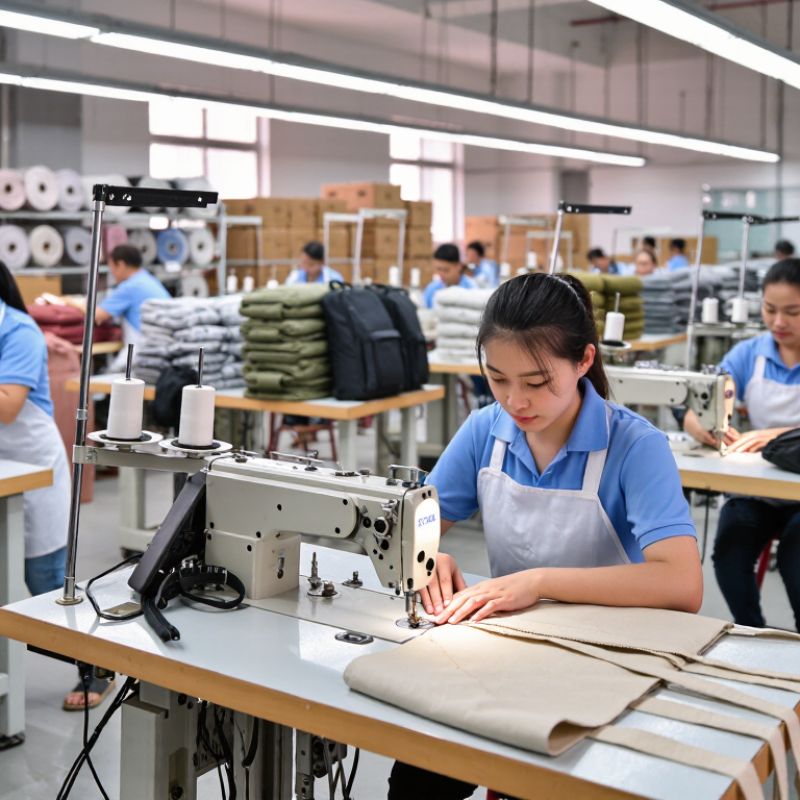
Vietnamese factories may handle cut-and-sew work across backpacks, luggage, shopping bags, and promotional products. The right match depends on construction complexity, order volume, and material requirements. Ask for a production sample, a clear bill of materials, and recent quality-control records. A useful factory visit follows the process from fabric storage to final packing, rather than stopping at a polished showroom. Capacity figures need context; available production lines can change with seasonal demand.

Supplier assessment is never perfect. A sample can look excellent while a large run reveals uneven stitching or color variation. Set measurable tolerances, agree on inspection points, and keep written approval samples. Inspect closely. Communication speed and early problem reporting matter alongside price. Some factories may not fit every specification, and that is worth learning before production begins.

Vietnam Bag Manufacturing: Regional Minimum Monthly Wages (2025)

Vietnam’s statutory monthly minimum wages in 2025 range from VND 3.45 million to VND 4.96 million, depending on region. These legal wage floors provide labor-cost context for comparing manufacturing locations; they are not factory quotes or a ranking of manufacturers. Source: Vietnam Government Decree No. 74/2024/ND-CP.

Comparing Manufacturers by Products, Capacity, and Standards

A useful comparison of Vietnam bag manufacturers starts with the product, not the catalog. A factory skilled in lightweight promotional totes may not be suited to structured backpacks with padded panels and several compartments. Ask for samples made with the same fabric, lining, zipper, and stitching you plan to order. Check seams at stress points and inspect how evenly the handles sit. Small flaws can signal a process that needs closer review.

Capacity figures need context. A stated monthly output may cover several product types, not your order alone. Ask how many production lines are available, what is currently scheduled, and how the factory handles peak periods. A sample production timeline can reveal whether cutting, sewing, and packing are coordinated. Ask for proof. A spreadsheet can still flatter a weak supplier.

Standards matter when they match the product and the buyer’s requirements. Request current audit or certification documents, then confirm their scope, site, and validity rather than relying on a logo in a presentation. Discuss material testing, inspection checkpoints, defect handling, and how changes are recorded. There is no perfect factory. A clear answer about a past production problem may be more useful than a flawless sales pitch.

How to Choose the Right Vietnam Bag Manufacturer

Choosing a Vietnam bag manufacturer starts with a clear product brief. Specify dimensions, fabric weight, lining, hardware, stitching, and packaging. Ask how the factory checks these details during production, not only before shipment. A reliable supplier should explain its sampling process, monthly capacity, and quality-control steps in practical terms. Request examples of inspection records or a walkthrough of the production floor when possible.

Small details matter. Request a pre-production sample made with the intended materials, then test the seams, zippers, handles, and loaded weight. Note any changes in writing. A polished sample can still hide production risks, so ask how defects are recorded and corrected across a full order. That takes time. It is worth it.

Evaluate communication as carefully as price. Ask who will manage your order, how often updates arrive, and how delays are handled. Confirm lead times, minimum quantities, payment milestones, and shipping responsibilities in a written agreement. Compare quotations line by line; a low price may exclude packaging or inspections. If a supplier avoids specific answers, treat that as useful information. No checklist catches everything, and a first order may reveal gaps in your own specifications too. Build in time for revisions rather than expecting every sample to be perfect.